main menu | site map | search | contact
Epigenesis:
The Growth of Form
Frey Science and Engineering Center,
University of
Saint Thomas, Saint Paul,
Minnesota USA

Frey Science & Engineering SE of Summit Ave &
Cretin: The
mural is located on the first floor of the Owens Science
Hall, the building towards the right pictured above. Visitors from a
distance might call
security service in advance to check on accessibility.
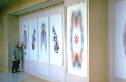
General view from the north side of
the hall.

click on sections for details
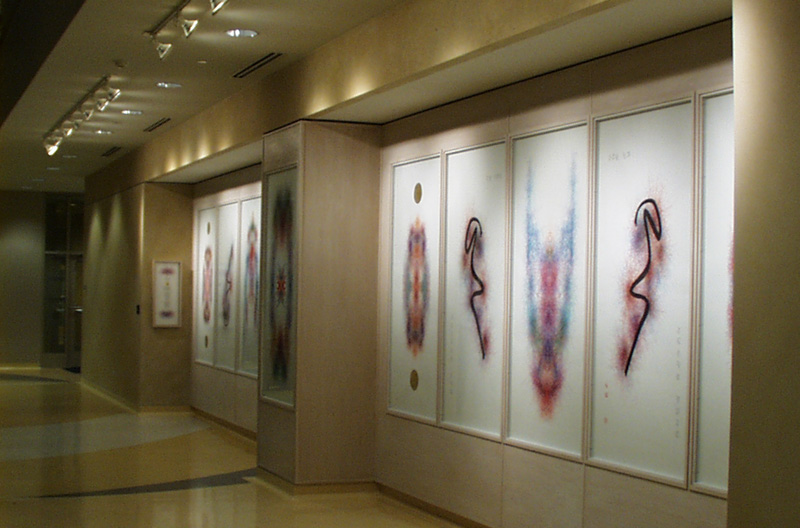
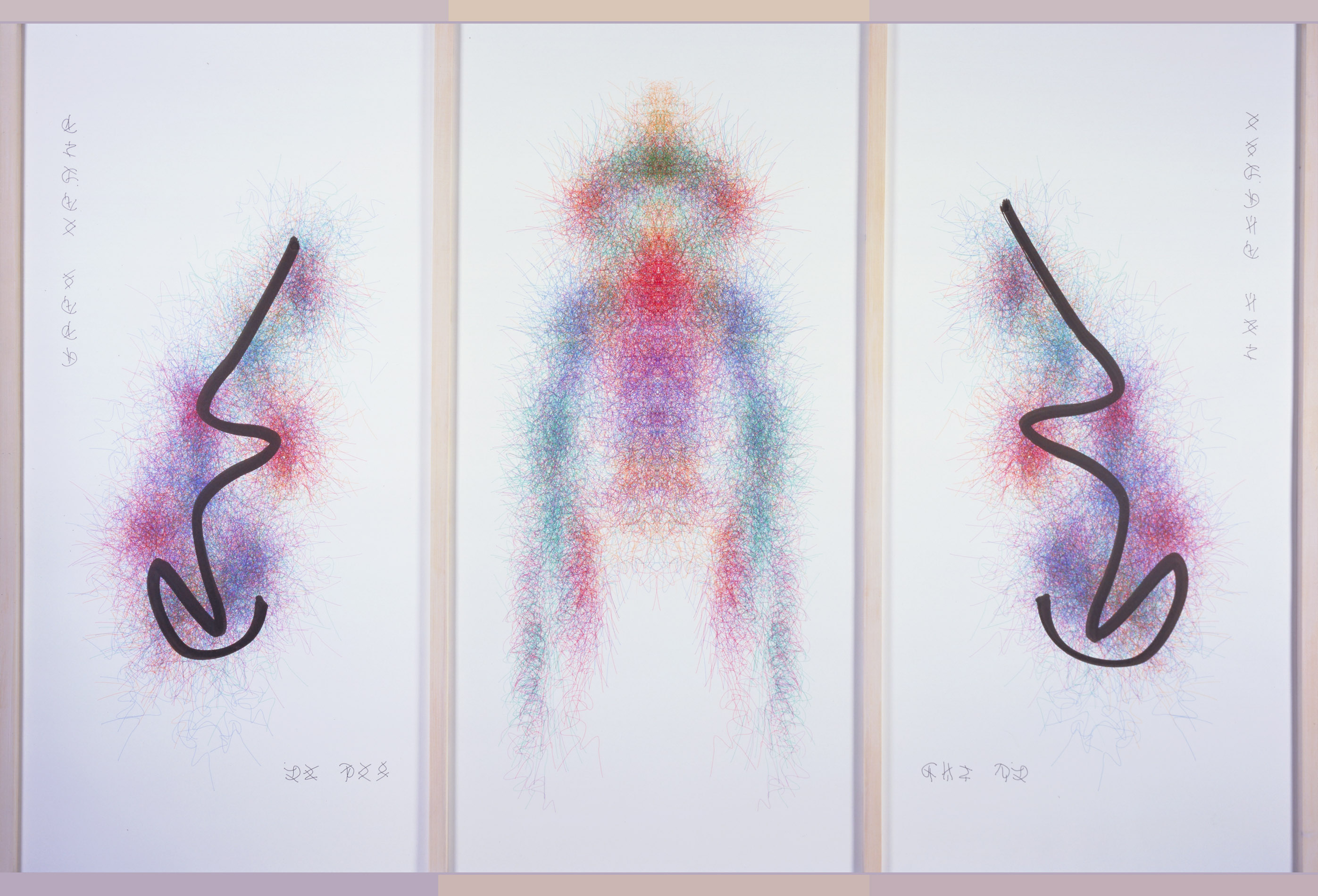
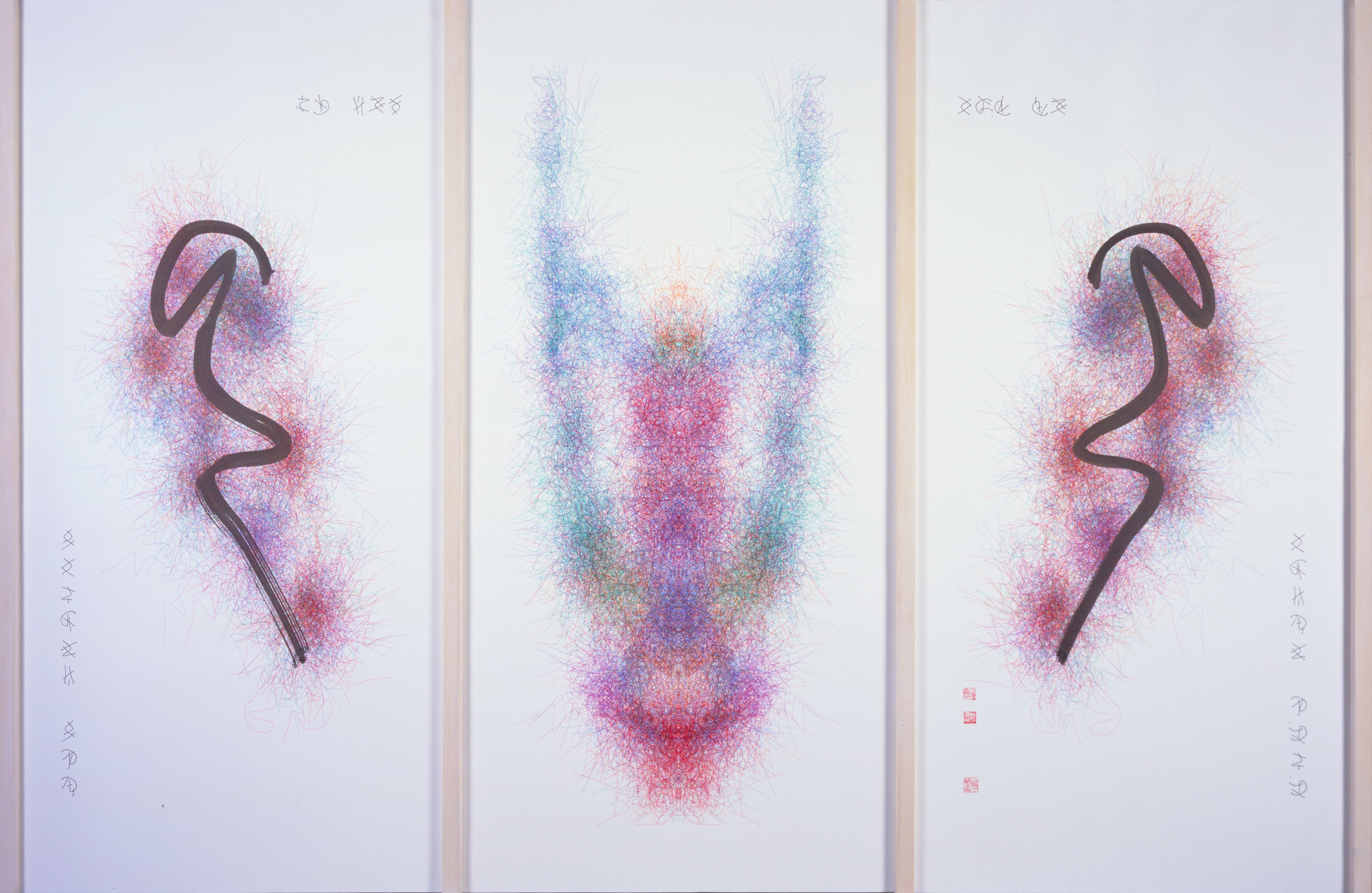
Site and structure. The University's Frey Science and Engineering Center was dedicated in September 1997. The mural project, located on the main floor of Owens Science Hall, employs technologies developed in the pioneer stages of the digital arts revolution. The project consists of eleven code-generated drawings in variations arranged as a visual syngraphy. Both pen & ink strokes and brush strokes were executed with a multi-pen drawing machine guided by original drawing instructions. Each pen-plotted unit was executed on Stonehenge paper measuring 3 feet by 6 feet. Installed in eleven units framed with oak paneling the finished project measures 40 feet by 9 feet, occupies two alcoves, and wraps around a central pilaster.
THE ELEVEN PANELS / click on units for larger images :
|
|||||
| left end | left triptych (3 units) | mid triptych (3 units) | right triptych (3 units) | right end | |

General view from the north side of the hall:
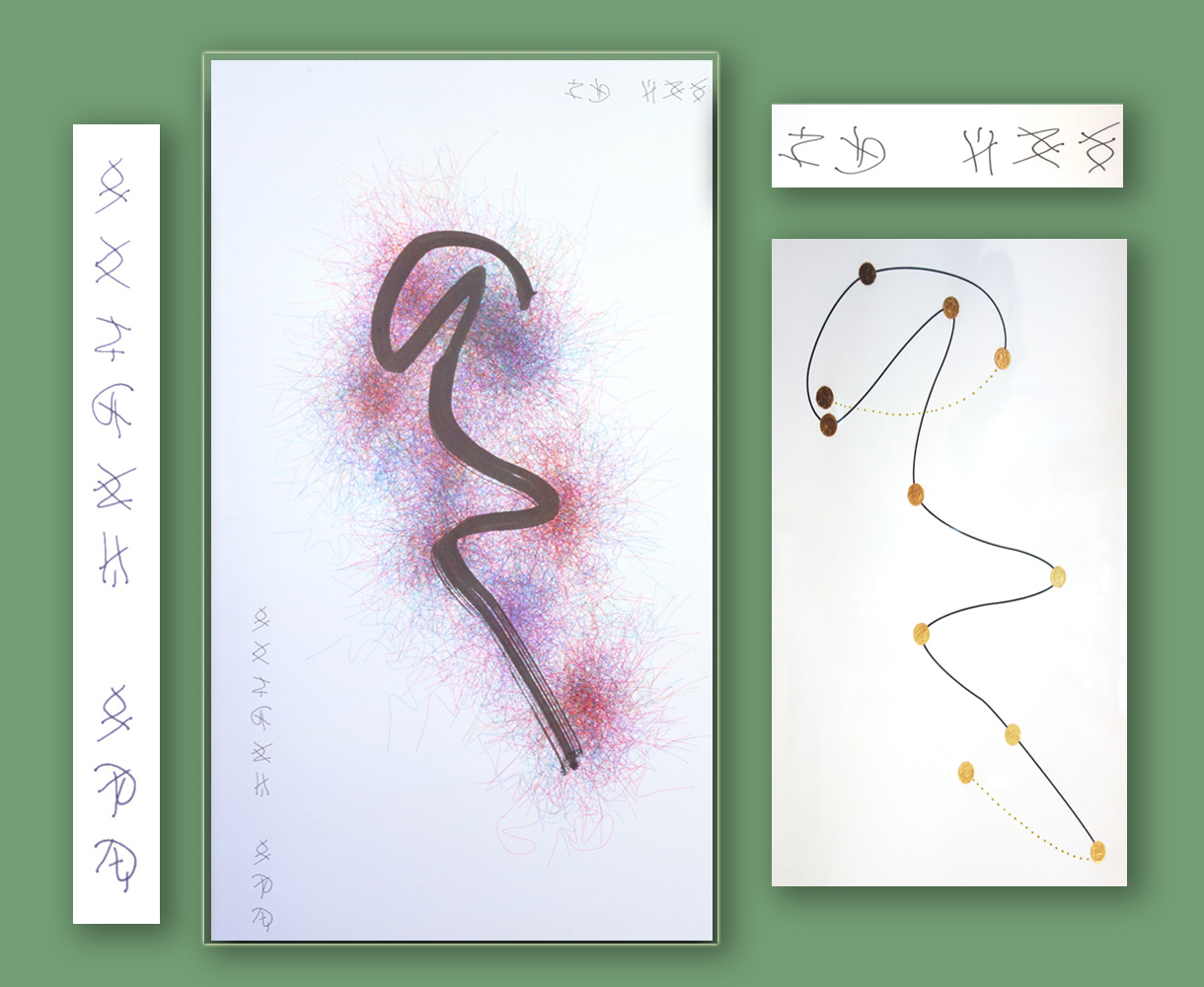 |
| Above: The eleven coordinates controlling the brush stroke are identified in the eleven golden orbs shown in the diagram on the right. The first and last coordinates have dotted lines connecting to the beginning and ending of the brush stroke. These two extra coordinates may be viewed as sleepers.. They determine the direction of the slope the brush will take for the beginning and ending of the stroke's curve. The smaller calligraphic strokes present visual variations based on the brush stroke curve. Technically this smooth curve stroke is called a "NURBS", (a non-uniform rational spline). |
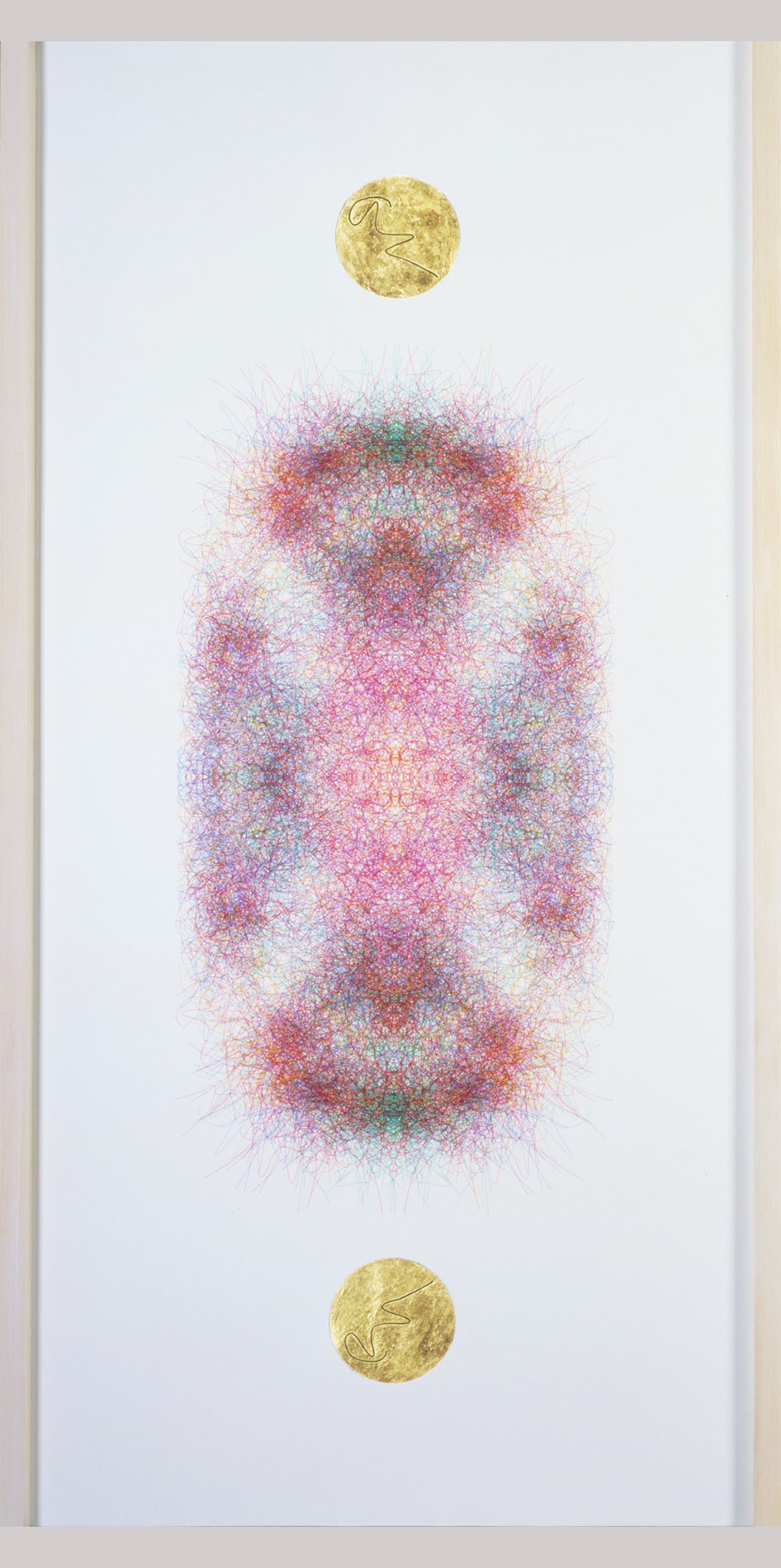
Brush Strokes. The brush strokes that mirror each other identify the initiating coordinates. Thousands of lines, derived from this initiating shape, cluster and mirror themselves throughout the eleven panels. In effect the mural displays the growth of form and, by analogy to the biological process, may be viewed as epigenesis. The smaller calligraphic strokes were code-generated with procedures drawing on the same controllers used for the brush strokes. I view them as pure visual form statements about the slope and curve information permeating the entire project. A "self-similarity" permeates the form variations as all share the same parent code.
 |
Above: The central geometric configuration was achieved with several series of parallel pen strokes generated with the very same coordinate information as used for the brush strokes and every other pen stroke in the entire mural. Gold leaf was applied by hand to the small center diamond that displays the key pen stroke. The pen stroke was code generated. and pen plotted. |
Interpretation and Title. These works may be viewed as visual analogues of the coded procedures by which they were made somewhat as the winding banks of streams display the traces of the forces with which they were shaped. From this perspective the mural displays the visual traces of the procedures with which it was shaped. Throughout the mural the form-generating process manifests itself in clustering webs of pen strokes with each stroke echoing the information contained in the initial eleven sets of coordinates. (click on image sections for larger details)
|
|
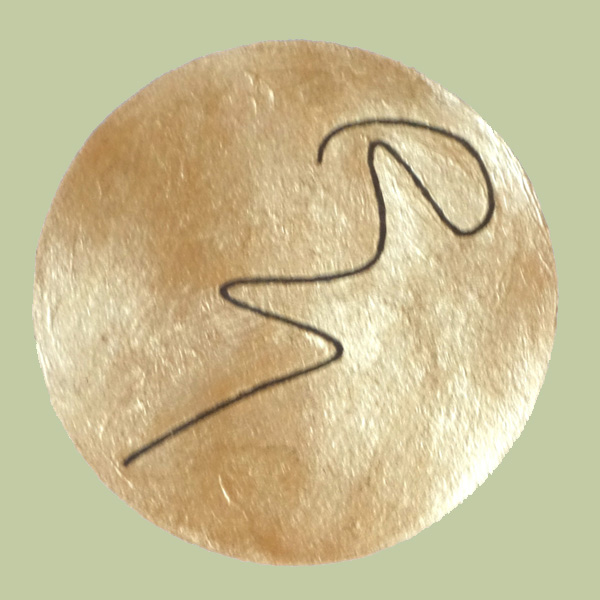
| Detail: 1 of the 4 gold leafed roundels. The black stroke inside the roundel was code generated and executed with a fine brush mounted on the plotter's drawing arm. Gold leaf was applied by hand in all instances. |
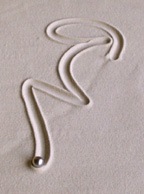 Sisyphus renders the stroke
- animated time warp (962 KB) ©
Sisyphus renders the stroke
- animated time warp (962 KB) ©
Above: The Saint Thomas brush stroke was rendered as a sand etching during the evening of December 10th, 1998 when I was visiting with Jean Pierre Hebert in his Santa Barbara studio. Jean Pierre had created several versions of a sand etching machine, Sisyphus, that plotted vector graphics on a sand surface with a steel ball. On that evening, while demonstrating how Sisyphus worked, he suggested that we make a photo sequence of Sisyphus executing the master brush stroke for the Epigenesis Mural. I provided the vector coordinates, Sisyphus executed the brush stroke and the time warp animation displays the path being traced in the sand.
Historical note on Epigenetic Art. Historically we had no term in the arts to identify the art-making process whereby works are generated by the artist's own coded procedures. In 1986 I set out in search of a term to identify my art-making process. In 1987 I settled on the term epigenetic as a specific descriptor of the algorithmic procedures for executing my algorithmic art. The following year I presented a paper identifying the biological analogues for art work created with art form generators (algorithms) created by artists. This paper, presented at the First International Symposium on Electronic Art (FISEA, Utrecht, 1988) and later published in Leonardo (23:1,1990), outlined the rationale for the use of this term.
Epigenetic by analogy only. The biological term epigenesis refers to the process whereby a mature plant, say an oak tree, is "grown" from an acorn that embodies the genotype for the tree. The procedure. the code, genotype, for growing the tree with all its branches and leaves, in every detail, is contained in the acorn. By analogy, an artwork such as this mural, is algorithmically "grown" from the software that contains all the form-generating instructions likened to "genotype". This procedure for generating the work may be viewed as epigenetic but only by analogy to the growing process. See my paper: "Epigenetic Painting: Software as Genotype" (Utrecht, ISEA, 1988).
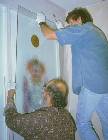 Installing the last unit (29kb), August
1997.
Installing the last unit (29kb), August
1997.
Installation. Work was installed in August 1997 using a reversible method as a conservation measure. The six foot paper units were hung on secure acid free backing and protected with UV filtering laminated glass. The frames and white stained oak panels were crafted by Don Zwernik who is shown with Roman installing the last unit.

Technical specifications:
- Software: Artist's code: plotter commands in DM/PL; program in BASIC.
- Computers: PC's operating on DOS.
- Plotters: Summagraphics HiPlot 7200, 36 inch bed multipen plotters.
- Paper: Rising Stonehenge, 245gm/m2. Eleven 3 foot by 6 foot pieces.
- Pens: Refillable technical pens, stainless steel and tungsten.
- Brushes: Oriental brushes adapted by the artist to operate on the plotter's arm.
- Inks: Light-fast acrylics mixed by the artist.
- Gold Leaf: Traditional gold applied by hand.
- Frames and paneling: Stained white oak.
- Glazing: 5/16 inch laminated glass.
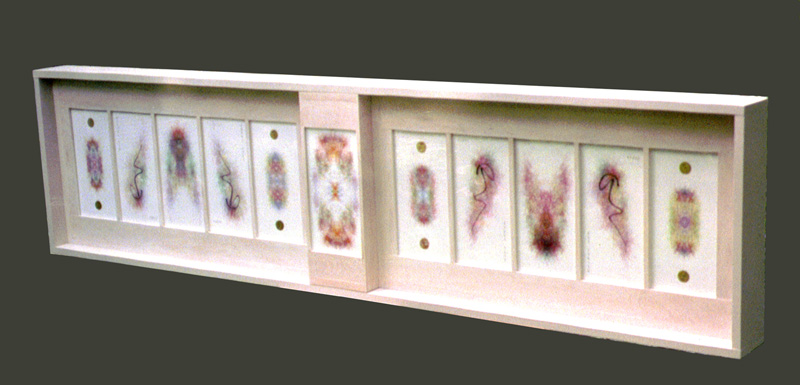
The 1996 Scale Model for Epigenesis. This preliminary model, a work of art in its own right, served as the first stage of this project. A second version of this model is permanently on display at the downtown Minneapolis campus of the University of St. Thomas (second floor, main overpass) Click below for model details.